Noise and machinery directive 2006/42/EC, measurement and CE marking.
Noise doesn't sell
A brief description of the requirements of the MD regarding noise
Machines and equipment must be designed and manufactured in such a way that the emission of noise is as low as possible.
Secondly the buyer and user must be informed about the residual risk caused by the noise emission of the product, if relevant.
For that reason the machinery directive requires that noise levels must be determined, preferably by measurement, and be declared in the manual and in sales literature.
Declaration of noise emission in the manual and sales literature
The noise level at a workplace of a machine (the so called emission sound pressure level) has to be specified in the user manual if it exceeds 70 dB(A). Sound power has to be determined and declared if the emission sound pressure level exceeds 80 dB(A). These requirements for the manual have to be met for legitimate placement in the EU market, but it also holds for home brew machinery. The aim of the directive is that users and buyers must be able to assess and compare machines on all aspects of health and safety, including noise. The machinery directive does not contain any noise limits imposed on products within its scope. Legislative noise limits do exist for exposure to noise at work and for some machinery intended for outdoor use (2000/14/EU).
Relation between directive and standards
The machinery directive contains no guidance nor any requirements regarding the execution of noise measurements.
Measurements procedures, so called noise test codes, can be found in standards.
If a standard on safety of a family of machines is harmonised, then it provide presumption of conformity with EU regulation.
If noise is covered by a harmonised standard it shall also contain a compliant noise test code.
But: the inclusion of noise is not required. The scope of a standard has to make clear if noise is relevant but not covered.
For fair comparison of products, noise measurements shall be executed in a repeatable way.
If there is no applicable harmonised standard, or when it is discarded, it takes a lot of extra effort to account for the validity of the noise specification thus obtained.
Therefor the use of a harmonised standard is strongly recommended, they make life easier.
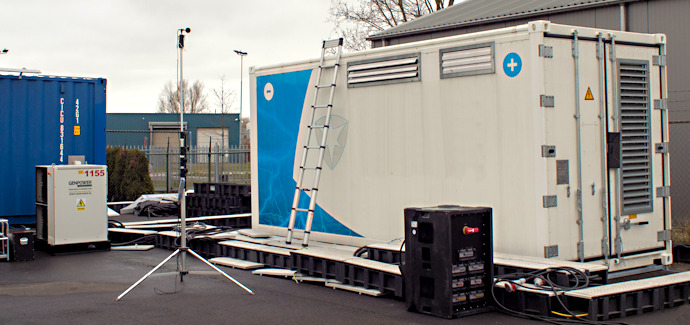
We can investigate if noise measurement at your site is feasible.
This depends mainly on the ratio between the volume of the device under test and the volume of the measurement space (if indoor)
and on the amount of acoustical absorption in that space. If the measurement can be executed outdoor then the background noise must be below certain limits.
Reproducible measurement
The aim of the standardised noise test codes is to obtain results which make
comparison of the noise emission of different products possible. To achieve this the measurement should take
place in an environment almost equivalent to that of an open space above a reflecting surface. Also the operating conditions
must be reproducible, and equal for all machines of the same family.
An open space above a reflecting surface can sufficiently be reached if the test object is small and the test room is
large, and has at least some acoustic absorption. The B-standards provide guidelines how to evaluate this.
Contrary to this, the standard to evaluate exposure to noise at workplaces of an employee
describes a survey method which results in a noise level that is representative for a specific workplace, working environment, function,
or group of persons. All factors in the specific environment which affect the noise exposure must be taken into consideration, something
that must be strongly avoided if specifications of a machine must be established.
Guide for manufacturers
In 2013 the issue of noise declarations of machinery was evaluated by an EU workgroup.
It appeared that there were many obstacles, and that only a minority of devices were accompanied by fully compliant noise specifications.
As a result the workgroup issued the NOMAD Guide for manufacturers,
this gives an overview of the process and guidance how to comply.
Technisch bureau van Eeden issued introduction to noise measurements on machinery.
Download the preview.
A hard copy is available for € 20,00 including shipping within Europe. Just write us an email (please include all company info).